article
How to Know If Anyone Will Pay for Your Idea (4 Tests)
How to know if people will actually pay for your idea — not just say they would. Four tests to validate willingness to pay before you build, the SLC framework, and the signals that separate real demand from polite feedback.

You have an idea. You're excited about it. But there's one question that keeps you up at night: will anyone actually pay for this?
The default approach is to build everything first, then find out. But that's expensive, slow, and risky. By the time you launch, you've invested months — or years — into something nobody may want. The better approach is to test willingness to pay before you build more than you need to.
Here's how to know if anyone will pay for your idea — with a framework that changes how you think about what to build first.
The short answer
Build the smallest complete version that solves one problem for one person. Put it in front of real people with real money. If they pay, you have signal. If they don't, you have data. Either outcome is valuable, but only if you ship early enough to learn from it.
Why most founders guess wrong
Most founders don't set out to waste time. They build features because it feels productive. But three patterns keep them from learning whether anyone will pay.
Building features nobody asked for. You add a dashboard, analytics, custom templates — not because users need them, but because your product "should" have them. Every extra feature delays the moment you learn the truth.
Mistaking polite feedback for real demand. Friends say "that's a great idea." Survey respondents say "I'd definitely use this." Neither one has pulled out a credit card. Polite feedback is cheap. Willingness to pay is expensive.
Building in stealth. You wait until the product is "ready" before showing anyone. But launch day is the first time your idea meets the market. If it fails, you've lost months with nothing to show.
The fix isn't to build faster. It's to build less, build the right thing, and test it with real people sooner.
The SLC framework
Jason Cohen wrote an article called Simple, Lovable, Complete that changed how I think about building products.
The standard advice is to build a minimum viable product. But "viable" is vague. It's easy to convince yourself that a feature is viable because it's useful, even if it doesn't directly solve the core problem.
SLC is more specific:
- Simple — The product does one job. Not five jobs badly. One job well.
- Lovable — The product does that one job so well that users actually enjoy using it. Not just "it works" — it's delightful.
- Complete — The user can achieve their goal without leaving your product or hitting dead ends. The experience doesn't feel unfinished.
The difference from MVP thinking is subtle but important. An MVP mindset says "what's the least we can build?" An SLC mindset says "what's the smallest thing we can build that someone would genuinely love using?" The bar is higher — but the scope is still tight.
Case study: How SLC shaped GetWaitly
When I started building GetWaitly, my plan looked like every other SaaS roadmap. Here's what I thought I needed in version one:
- A drag-and-drop landing page editor
- Multiple landing page templates
- Customizable thank-you pages
- Full analytics with charts and trends
- A ton of customization options
I kept adding to the list. The more I worked on it, the further launch day felt. Every feature seemed important. But I was building for imaginary future users — not for the person who needed a waitlist today.
Then I read the SLC article. One idea stuck: a product doesn't have to do everything. It has to completely solve one problem for one group of people.
I started asking a different question. Instead of "is this feature useful?", I asked "can someone launch a waitlist without this?" If the answer was yes, it didn't belong in version one.
Here's what that meant in practice:
- The drag-and-drop landing page editor was cut entirely. Founders already have a site or a Carrd page — GetWaitly's job is to embed a branded signup form into what they have, or give them a simple hosted page, not to be a full page builder.
- Multiple landing page templates were cut. You don't get to customize structure — only content and branding.
- Customizable thank-you pages were cut entirely. The standard one works fine for the first 100 users.
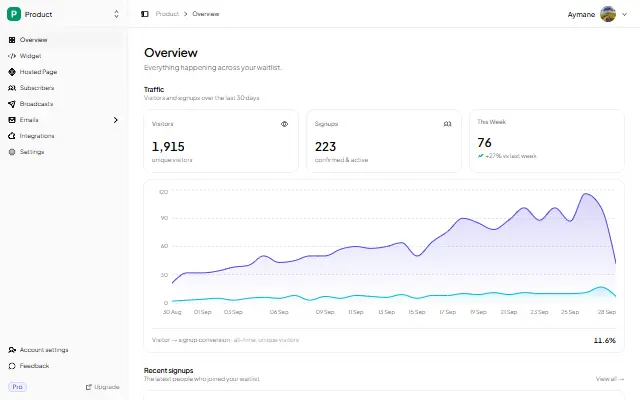
- Analytics was simplified to what early founders actually need — views, signups, conversion rate. No heatmaps, no funnels, no trends.
It felt strange removing work I'd already done. But the result surprised me. The product became easier to understand. Onboarding got simpler. Every feature had a clear reason to exist. And most importantly, I reached a launchable product faster than I would have with the original plan.
That version shipped, got its first users, and validated that founders wanted a simple, affordable waitlist. The SLC framework didn't just help me build less — it helped me build what actually mattered. Since launch, the product has grown to include referral links, broadcast emails, and analytics — all shaped by the same question: does this help someone launch and grow their waitlist?
It doesn't matter how polished your MVP is if nobody actually wants it. I'd rather have a smaller product in front of real users than spend months building features they may never use.
4 ways to test willingness to pay
Your story will be different. But the principles are the same. Here are four methods to test whether anyone will pay for your idea, ordered from lowest to highest effort.
Method 1: Pre-sell before you build
Create a simple landing page that describes what you're building and how much it costs. Include a "buy now" or "join waitlist" button. Drive traffic to it using communities, social media, or ads.
If people click the button, that's signal. If they don't, you know before you write code. A landing page with a clear price filters out polite feedback — people either take action or they don't.
Best for: Ideas where you can describe the value without showing the product.
Method 2: Concierge MVP
Deliver the core value manually. If you're building a tool that schedules social media posts, schedule posts for your first 5 customers by hand. If you're building a reporting dashboard, generate reports manually and email them as PDFs.
This sounds inefficient — and it is. But it's the fastest way to learn whether people want what you're offering. If they stick around and keep paying, you have proof. Then you automate.
Best for: Services, B2B tools, and ideas where you can replicate the outcome without building the full product.
Method 3: Landing page with pricing
Similar to pre-selling, but you show specific pricing tiers. This reveals not just whether people want your product, but what they're willing to pay and which features matter most.
Track which tier gets the most clicks. If nobody picks the basic tier, the entry price is too high. If everyone picks the cheapest, your perceived value doesn't justify the price.
Best for: Products with clear pricing tiers and feature differentiation.
Method 4: Waitlist with referrals
Set up a waitlist page where people can join and get a unique referral link. Track how many sign up and, more importantly, how many share their link.
People who share your waitlist are telling their friends about you unprompted. That's a stronger signal than a signup. It means they'd miss it if it disappeared. And if you combine this with a pre-launch email sequence, you can gauge engagement through open rates and replies.
If a waitlist is the right approach, GetWaitly makes it easy — an embeddable signup form, referral system, and subscriber management in one tool.
Best for: Pre-launch campaigns, products that benefit from social proof, and founders who want to build momentum before shipping.
Weak signals vs strong signals
Not all feedback is equal. Here's how to tell what matters.
| Signal | What it really means |
|---|---|
| "Great idea!" | They're being polite |
| "I'd use this" | Maybe, if it's free |
| "I'd pay for this" | Maybe — words are cheap |
| Email signup | Mild interest |
| Referral share | Genuine interest (they're risking reputation) |
| Credit card number | Proof |
| Second payment | Retention — real value |
One credit card swipe is worth a hundred "great idea" comments. One referral share tells you more than a survey with perfect scores.
When you know it's real
You don't need hundreds of paying users to know you're onto something. Look for these signals:
- Someone pays before the product is finished
- People share your waitlist link without being asked
- Users email you asking when they can use it
- A stranger — not a friend — says they'd be disappointed if the product disappeared
Any of these is stronger evidence than all the positive survey responses in the world.
If you see none of these signals after genuine effort, you have data. The problem might not be painful enough, the audience might be wrong, or the solution might miss the mark. That's not failure — it's learning before you've spent your runway.
FAQ
How do I know if my idea is worth building?
Build the smallest version that tests whether someone will pay. If you can get a pre-order or a credit card before writing code, you have your answer. If nobody bites after honest effort, either the problem isn't painful enough or your message isn't connecting. Both are fixable — but you need the data first.
Should I build a landing page first or a full product?
Landing page first, always. A landing page with a pricing table and a signup button tells you more in a week than building for a month. If you can't get signups from a page that clearly communicates value, a product won't fix that.
What if nobody signs up?
That's data, not failure. Either the problem isn't urgent, your message doesn't connect, or you're targeting the wrong audience. Change one variable at a time and try again. If you still get nothing after multiple iterations, you've learned something valuable before spending months building.
How much should I charge?
Charge enough that the transaction feels real to both sides. If you charge $5, people will sign up out of curiosity. That doesn't validate demand. Charge what a real solution to the problem is worth — even if it's just for a pre-sale or early access.
How do I know if people will pay for my product?
Ask them for money before the product exists. Pre-sell it, take a deposit, or put a price on a landing page and see if anyone clicks "buy." Willingness to pay is revealed by action, not opinion — a single pre-order outweighs a hundred "I'd definitely use this" replies. If nobody will pay in advance, you've learned that cheaply, before spending months building.
How do I test if people will pay for a specific feature before investing heavily?
Test the feature, not the whole product. Describe the feature on a landing page as if it were a stand-alone product, put a price on it, and drive real traffic — if people won't click "buy," they won't pay once it's buried inside your app either. You can also pre-sell it as an add-on or a paid tier and see who upgrades. The point is the same as validating an entire idea: get a real transaction before you spend weeks building. If the feature can't earn its own pre-orders, it usually can't earn a place on your roadmap.
How many people do I need to survey to know if people will pay?
Surveys are the weakest form of evidence, so the honest answer is: none that you should fully trust. People are unreliable at predicting their own spending. Use conversations to understand the problem, but validate with a real transaction. Ten people who pay beat a thousand who say they would.
What's the fastest way to test if people will pay?
Put a price in front of real traffic this week. A one-page landing page with a clear offer, pricing, and a buy button can be live in an afternoon. Drive 100-200 visitors from a community or social post. If nobody takes the paid action, iterate the message or the offer — not the product.
Related guides
- How to Validate a SaaS Idea Without Building Anything — five approaches to validation before you write code
- Why Most Pre-Launch Campaigns Fail (And How to Fix Yours) — six predictable failure modes and how to address each one
- How to Build an Audience Before Your Product Is Ready — building trust and interest before launch day
- How to Launch on Product Hunt — turning validated interest into a successful launch
- Why Most Side Projects Die (And How to Beat the Odds) — three root causes of lost momentum and how to build around them
- How to Price Your SaaS Product (With No Customers Yet) — turning willingness-to-pay signals into an actual price
Ready to test your idea?
The fastest way to know if people will pay is to put something real in front of them. A waitlist with a referral system lets you capture interest, measure engagement, and build momentum — all before you ship. Start a free waitlist in 5 minutes. No credit card required.

written by
Aymane E.
Founder of GetWaitly. I write about validating ideas, pre-launch, and growth from building a waitlist tool as a solo founder.
Follow on X