article
How to Build an Audience Before Launch (With No Followers)
How to build an audience from zero before launch: content marketing, community engagement, and building in public — plus why a waitlist is the best destination for every audience-building effort.

You have an idea. You're ready to build. But you have one problem: nobody knows who you are.
Starting from zero is the default state for most founders. The temptation is to build first and figure out distribution later — but that's why most launches land in silence. The fix is counterintuitive: start showing up before your product is ready. The right time to begin is the day you decide to build, not the day you launch.
Here's how to attract people before you have anything to ship, with the strategies that actually work for solo founders on a zero-dollar budget.
The audience building strategies that work pre-product
Every audience building strategy trades time for trust. Some are faster but shallow. Others take months but compound. The key is picking the right mix for your personality and timeline.
Option 1: Content-first
You create helpful content around the problem you're solving — blog posts, Twitter threads, LinkedIn articles, YouTube videos. Each piece answers a question your future users are searching for.
When it works: You enjoy writing or creating content, and you're in a space where people search for answers. B2B SaaS is ideal for this.
Where it falls short: It takes 3-6 months to see meaningful traction. Most people quit after 10 posts with zero engagement. Content marketing is a marathon, not a sprint.
Best for: Founders who can commit to publishing consistently for at least 3 months without seeing results.
Option 2: Community-first
You join existing communities where your target audience already hangs out — subreddits, Discord servers, IndieHackers, niche forums. You add value to conversations, answer questions, and build relationships.
When it works: You know exactly where your users spend their time. You enjoy conversations and can be genuinely helpful without expecting anything in return.
Where it falls short: Each community has its own culture and norms. Show up selling and you'll be banned. It takes time to build reputation before people trust your recommendations.
Best for: Founders who are naturally helpful and enjoy being part of online communities.
Option 3: Lead magnet
You create a free resource related to your product's space — a checklist, template, guide, or mini-course. People trade their email to access it.
When it works: You can create something genuinely useful in a few hours. The lead magnet should solve a specific, immediate problem — not be a vague "free ebook."
Where it falls short: Distribution is still the bottleneck. A lead magnet without traffic captures zero emails. You need a way to get it in front of people.
Best for: Founders who want to build an email list quickly and have a clear, valuable offer to give away.
Option 4: Building in public
You share your journey transparently as you build — the good, the bad, and the ugly. You post progress updates, lessons learned, and behind-the-scenes decisions on X, LinkedIn, or a personal blog.
When it works: You're comfortable being visible and can share authentically. People follow journeys, not products. Building in public attracts an audience that cares about you, not just your tool.
Where it falls short: It requires consistency over months. Posting once a week won't build momentum. You also need to share genuine struggles — no one follows a highlight reel.
Best for: Founders who enjoy sharing their process and can post daily or near-daily.
Option 5: Waitlist as audience magnet
You create a simple waitlist page for your product and use it as the destination for every audience-building effort. Every piece of content, every community conversation, every update — all point to the same waitlist.
When it works: You want every audience-building effort to result in a concrete, measurable outcome — not just followers or likes, but email subscribers who've opted into your product.
Where it falls short: A waitlist page alone attracts no one. You still need to drive traffic. It's a conversion tool, not a discovery channel.
Best for: Founders who want to validate demand while building an audience, and who plan to use multiple channels to drive traffic.
Audience-building strategies compared
| Approach | Time to first 100 | Effort | Long-term value | Best when |
|---|---|---|---|---|
| Content-first | 3-6 months | High | Very high | You enjoy creating and can be patient |
| Community-first | 2-4 weeks | Medium | Medium | You know where your audience hangs out |
| Lead magnet | 1-4 weeks | Medium | Medium | You have a specific, valuable offer |
| Building in public | 2-6 months | High | High | You enjoy sharing your journey |
| Waitlist + traffic | 1-4 weeks | Low (with existing traffic) | High | You want measurable validation + growth |
The best approach for most solo founders? Combine community-first and building in public, with a waitlist as the destination. Communities give you early traction. Building in public compounds it. And a waitlist captures everything in one place.
How to build an audience from zero: the 6-step playbook
Here's the playbook I'd use as a solo founder starting from zero.
Step 1: Define your niche and who you're building an audience for
You can't build an online audience for everyone. Pick a specific group of people with a specific problem. "Founders building B2B SaaS" is better than "entrepreneurs." "Freelancers who struggle with late payments" is better than "small business owners."
The narrower your niche, the easier it is to attract the right people.
Step 2: Pick one primary channel
Don't try to be everywhere. Pick one platform where your target audience spends time and go deep. For most founders, that's X (Twitter) or a niche subreddit. For B2B founders, LinkedIn can work. For consumer products, TikTok or Instagram.
One channel, consistently, for 90 days. Add others later.
Step 3: Create a destination
Set up a waitlist page for your product. This is where every audience-building effort points. A single link in your bio. A single URL in your posts. One place where interested people can raise their hand.
Make the page clear: what problem you solve, who it's for, and what happens when they sign up. Nothing fancy — one headline, one paragraph, one email field.
Step 4: Share your journey
Post daily about what you're building. Not features — struggles, decisions, lessons. "I spent 4 hours debugging a CSS issue" is more relatable than "we just shipped v2.0." People follow people, not products.
Include your waitlist link naturally. "Building a tool to help freelancers track invoices. Join the waitlist if that sounds useful to you."
Step 5: Engage, don't broadcast
Reply to people in your space. Share their content. Add thoughtful comments. Building an audience is a two-way conversation, not a megaphone. For every post you make about your product, make 5 that are helpful to others.
Step 6: Compete on helpfulness
Look for questions your target audience is asking. Answer them thoroughly. If you're building invoicing software for freelancers, search X for "freelancer invoice late payment" and help people who are struggling. Your answer can end with: "I'm building a tool for this exact problem — happy to share early access if you're interested."
Zero-budget hype tactics
These four tactics create buzz without ad spend. Use them as you build your audience.
- Strategic partnerships. Find 3-5 complementary products or creators whose audience overlaps yours, and offer to cross-promote — a guest post, a joint email, a co-hosted event. They get content for their audience; you get exposure to new people.
- The countdown. Set a public launch date and post weekly updates: "X days until launch. Here's what I'm working on today." A visible deadline gives people a reason to check back and follow along.
- Scarcity, only when it's real. "First 100 signups get early access" works because it's true. Fabricated scarcity reads as manipulation and erodes trust.
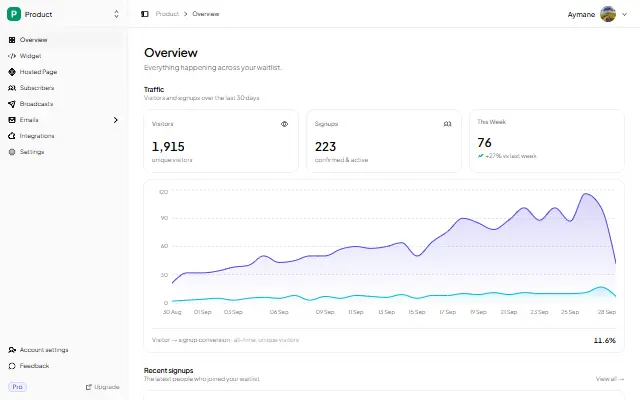
- Social proof stacking. Show a live subscriber count. Every signup makes the next one more likely — seeing others join is its own pitch.
What 90 days of consistency looks like
| Week | Action | Expected followers | Expected waitlist signups |
|---|---|---|---|
| 1-2 | Define niche, set up waitlist, start posting | 0-50 | 0-5 |
| 3-4 | Daily posts, engage with 10 people/day | 50-150 | 5-20 |
| 5-8 | Build in public, share lessons, answer questions | 150-500 | 20-50 |
| 9-12 | Momentum builds, referrals activate, content compounds | 500-1000 | 50-150 |
These numbers assume consistent daily effort. Results vary by niche and execution quality. But zero effort guarantees zero results.
When not to build an audience pre-product
Building an audience before your product is ready isn't always the right move.
- You need revenue now. Audience building takes months. If you need cash flow this month, sell your product first, build an audience alongside.
- You're in a crowded space. If your niche is saturated, standing out requires exceptional content or a unique angle. Consider a different approach.
- You hate being visible. Not everyone enjoys posting publicly. That's fine — focus on community engagement or content marketing, which require less personal visibility.
The point of building an audience before product
When you launch, most people won't buy on day one. They need to see you exist, see others using your product, and build trust over time. Starting that trust-building process before you launch means launch day isn't day zero — it's day 90.
Every person who joins your waitlist before you launch is someone who already knows, likes, and trusts you. They're not cold traffic. They're warm leads who've been following your journey for weeks or months. And those are the people who turn into your first paying customers.
Your product is what you build. Your audience is what you build it for. Don't wait until launch day to meet them.
FAQ
How to build an audience from scratch with no followers?
The most effective audience building strategy when starting from zero is to pick one channel, create helpful content, and engage consistently. Start before your product is ready. Choose where your target audience spends time — X, Reddit, LinkedIn. Create content that answers their questions. Engage in conversations. Share your building journey. Set up a waitlist as a destination for everyone who finds you. Consistency over 90 days compounds into real traction — the first 30 days feel slow, but month three is where momentum builds. To build an audience online with no budget, focus on communities where your future users already gather and add value before promoting anything.
What is audience building and why does it matter before launch?
Audience building is the process of attracting and growing a group of people who are interested in what you're building. It matters before launch because launch day with zero audience means launching to silence. An audience gives you warm leads who already trust you — they've followed your journey, read your content, and know your product is for them. Starting this process before you ship means launch day isn't day zero, it's day 90.
What's the difference between building an audience and creating an audience?
They're the same goal — attracting interested people to your product. "Building an audience" implies gradual growth through consistent effort. "Creating an audience" implies launching something (a lead magnet, a viral post, a product launch) that attracts attention quickly. Both work. Building is slower but compounds. Creating is faster but requires a hook. Most successful founders use both: create moments of attention that feed a longer building process.
What if nobody shares my content or waitlist?
Low sharing usually means either the message doesn't resonate or the audience is wrong. Test different angles and different communities. If you still get zero engagement after iterating, you've learned something valuable before investing months in building.
Related guides
- Building in Public: What Actually Works for Solo Founders — the daily practice of sharing your journey to build trust and attract followers
- Email vs Waitlist vs Landing Page: Which Comes First? — choosing the right channel for capturing and growing your audience
- How to Know If Anyone Will Pay for Your Idea — testing willingness to pay once you have an audience to test with
- The Solo Founder's Pre-Launch Playbook — turning your audience into launch day momentum
- How to Get Your First 100 Users — converting your audience into active users
- Why Most Side Projects Die (And How to Beat the Odds) — understanding what kills solo projects and how to stay on track
- Soft Launch: How to Run a Soft Launch Campaign (4 Approaches) — using a soft launch to test with your new audience
- Product Hunt Launch Guide + Checklist (30-Day Timeline) — turning your audience into a launch day spike

written by
Aymane E.
Founder of GetWaitly. I write about validating ideas, pre-launch, and growth from building a waitlist tool as a solo founder.
Follow on X