article
How to Validate a SaaS Idea Without Building Anything
How to validate a SaaS idea before writing code: surveys, concierge MVPs, landing pages, and waitlists compared — plus how to read the demand signals, set a signup threshold, and avoid false validation.

You have an idea. You think it's good. Your friends say it's good. A stranger on Reddit even said "someone should build this." But none of that tells you whether people will actually pay for it.
The #1 reason indie projects fail isn't bad execution — it's building something nobody wants. The fix? Stop building and start testing. But not all validation methods are created equal.
Here's a look at the most common approaches, when each one works, and when to reach for a waitlist.
I've run this process myself — GetWaitly started as a validation exercise before it was a product. Building the waitlist first, and watching who actually signed up, told me more than months of planning would have. The methods below are ranked by the strength of the signal they give you, not by how comfortable they feel.
How to validate a SaaS idea: the options
Every validation method asks people to take some action. The question is: what action tells you the most, with the least risk?
Option 1: Surveys and interviews
You ask potential users what they need. This is where most founders start.
When it works: You're exploring a new space and don't know the problem well yet. Conversations are great for discovery — they reveal language people use, frustrations they feel, and features they assume they want.
Where it falls short: People are bad at predicting their own behaviour. Someone will tell you "I'd definitely pay for that" in a survey and never open the email when you launch. Intent and action are different things.
Best for: Early exploration, not validation.
Option 2: Concierge MVP
You manually deliver the service you plan to automate. No code, no product — just you doing the work for a handful of people.
When it works: You're solving a high-value problem where people will tolerate an imperfect, manual process. Concierge MVPs give you the richest signal possible — people paying real money for a service you deliver by hand.
Where it falls short: It doesn't scale, and it doesn't work for every type of product. If your idea is a self-serve tool (most SaaS), doing it manually might not reflect the actual product experience.
Best for: Service-like products, high-ticket B2B, or when you want the strongest possible signal before building anything.
Option 3: A landing page with a signup
You put up a page describing what you're building with an email capture field. If people sign up, you have a lead.
When it works: You have distribution — social followers, email list, or organic traffic — and can drive people to the page. Landing pages are quick to set up and give you a sense of messaging effectiveness.
Where it falls short: A landing page in isolation (without traffic) tells you nothing. Many founders put up a page, get zero visits, and conclude the idea is bad. The real failure is distribution, not demand.
Best for: Testing messaging and headlines when you already have an audience.
Option 4: A waitlist
A waitlist is a landing page plus one critical feature: a reason for people to join early and share with others. It captures intent, and with referrals, it grows itself.
When it works: You're pre-launch, have no audience yet, and need both validation and growth in one shot. A waitlist gives you a real demand signal (email signups) while building the list you'll launch to.
Where it falls short: If you can't articulate the problem clearly, nobody will sign up regardless of the method. A waitlist also requires some ongoing attention — you need to engage subscribers while you build.
Best for: Solo founders with no existing audience who want to validate and grow simultaneously.
Validation methods compared
| Approach | Signal strength | Effort | Best when |
|---|---|---|---|
| Surveys / interviews | Low | Low | You're exploring, not validating |
| Concierge MVP | Very high | High | High-ticket, service-like products |
| Landing page | Medium | Low | You already have distribution |
| Waitlist | High | Low-Medium | You have no audience and need to grow one |
None of these is the "right" answer for everyone. The best approach depends on what you're building, who you're building for, and what resources you have.
When a waitlist is the right call
If you're a solo founder with a B2B SaaS idea, no existing audience, and a clear problem you can articulate in a sentence — a waitlist is probably your best move. Here's why:
- It validates and grows at the same time. You're not just testing demand; you're building the list you'll need on launch day.
- It rewards sharing. A referral system means every subscriber recruits more — turning validation into momentum.
- It captures intent you can act on. Email signups aren't as strong as pre-orders, but they're much more real than survey responses.
And critically: you can set one up in an afternoon. If you spend a weekend running a concierge MVP, you've invested significantly before knowing if the idea has legs. A waitlist costs you an hour.
How to validate with a waitlist
If you've decided a waitlist is the right tool for your situation, here's how to use it effectively.
Step 1: Define the problem, not the solution
Articulate what you're solving in one sentence. If you can't, you're not ready to test anything.
Bad: "AI-powered project management for remote teams" Good: "Remote teams waste 4 hours a week on status meetings"
Lead with the pain. People join waitlists because they want a problem solved, not because they're excited about your technology.
Step 2: Create a minimal pitch
You need a single paragraph that names the problem, hints at the solution, and tells people what happens when they join.
Here's a template:
Tired of [specific pain]? We're building [solution] so you can [desired outcome]. Join the waitlist for early access and launch updates.
Step 3: Share it where your audience hangs out
For founders, that typically means:
- IndieHackers.com
- Relevant subreddits (r/SaaS, r/Entrepreneur, r/SideProject)
- X / Twitter with hashtags like #buildinpublic and #indiehacker
- Discord communities focused on your niche
Post a genuine message: "I'm working on [problem] for [audience]. Anyone else feel this pain? Join the waitlist if you're interested."
Step 4: Set a signal threshold
How many signups count as validated? For B2B SaaS:
- 0-10 signups: Your problem statement isn't sharp enough, or you're in the wrong channels
- 10-50 signups: You're onto something. Engage with these people.
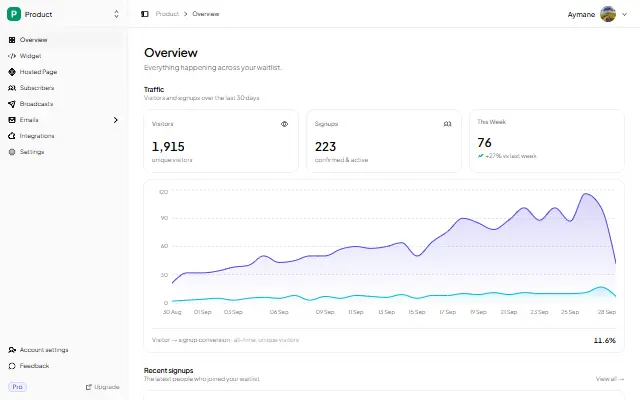
- 50-200 signups: Strong signal. You've identified a real pain.
- 200+ signups: Build. Now. You have demand.
The exact number matters less than the trend. Consistent signups from your target audience is real evidence.
Step 5: Talk to your signups
Send a welcome email with one question: "What's the hardest part of [problem] for you right now?"
Your first 10 signups know more about the problem than you do. Their answers will shape your roadmap more than any feature list you could come up with alone.
What validation looks like in practice
Say you're building a tool that helps freelancers track their invoices. You post in r/freelance: "I'm building something to solve the 'I forgot to send an invoice' problem. Anyone want early access?"
You get 12 signups in the first day, 37 by the end of the week. You send a welcome email asking about pain points. Most say: "Following up on late payments." That's a different problem than you planned to solve — and it's more valuable.
That's validation working. You didn't build a thing. You learned what to build.
When not to trust a waitlist
A few caveats:
- Signups from the wrong audience don't count. B2B validation requires B2B signups.
- Vanity metrics are not validation. 500 signups from a viral post mean less than 20 from people who match your target user exactly.
- If nobody signs up, it might not be the idea. It might be your messaging, channel, or timing. Try a different angle before giving up.
The point of idea validation
Validation isn't about proving your idea is right. It's about giving yourself permission to build with confidence — or the clarity to pivot before you've sunk months into the wrong thing.
A waitlist with 20 real, engaged signups tells you more than a year of building in the dark. But it's one tool among several. Choose the approach that fits your situation, and let the market tell you what to build next.
FAQ
How to validate a SaaS idea without building anything?
The fastest way to validate a SaaS idea without building is to create a waitlist page that describes the problem you solve and collects email addresses. Share it in communities where your target audience spends time. If people sign up, you have demand. If they don't, adjust your messaging or your idea. The key is to test the problem, not your solution. A waitlist with 10-50 engaged signups from your target audience is stronger validation than any survey.
What is the best way to validate a startup idea?
The best way to validate a startup idea depends on your situation. Surveys are fast but unreliable. Concierge MVPs give the strongest signal but take more effort. Landing pages work if you have distribution. A waitlist is the best balance of speed, effort, and signal strength for solo founders — it validates demand and builds your launch list simultaneously. The table in the validation methods section above compares each approach.
What is SaaS idea validation?
SaaS idea validation is the process of testing whether people want your product before you build it. It means collecting evidence that a real, specific audience has the problem you are solving — usually by asking them to take a small action, like joining a waitlist or paying for a concierge version. It is not a survey, and it is not asking friends if they like the idea. It is measurable demand you can act on.
How many signups do I need to validate my idea?
0-10 means your message or channel needs work. 10-50 is promising — engage with these people to refine your product. 50-200 is a strong signal that you've identified a real problem. 200+ means build now. The trend matters more than the absolute number.
Can I validate a SaaS idea without building anything?
Yes. A waitlist, landing page, surveys, and concierge MVPs all let you test demand before writing code. The goal is to see if people will take an action that costs them something — their email, their time, or their money — before you invest in building the full product. A waitlist is the most common approach because it's fast, low-effort, and doubles as your pre-launch audience.
Related guides
- How to Know If Anyone Will Pay for Your Idea — testing willingness to pay before you build the full product
- Email vs Waitlist vs Landing Page: Which Comes First? — choosing the right channel for your stage and sequencing them effectively
- How to Build an Audience Before Your Product Is Ready — audience-building strategies that feed into any validation method
- Why Most Side Projects Die (And How to Beat the Odds) — understanding what kills momentum and how to avoid it
- How to Price Your SaaS Product (With No Customers Yet) — testing a price as part of validating demand
Ready to validate your idea? The simplest waitlist for founders and makers. Start free in 5 minutes →

written by
Aymane E.
Founder of GetWaitly. I write about validating ideas, pre-launch, and growth from building a waitlist tool as a solo founder.
Follow on X