article
Why Pre-Launch Campaigns Fail: 6 Mistakes (and How to Fix Them)
Six predictable reasons pre-launch campaigns fail — building in stealth, no audience, one channel, no email capture, untested messaging, no referrals — with the fix for each. Plus how to tell if it's your product or your distribution.

You spent months building. You polished the landing page. You scheduled launch day. And then… nothing. A few page views. Maybe a handful of signups. Then silence.
This isn't bad luck. It's a predictable pattern — one that plays out every day in every corner of the founder space. The good news is the failure modes are well understood, and each one has a straightforward fix.
Here's why pre-launch campaigns fail and how to make sure yours doesn't.
The short answer
Pre-launch campaigns fail because founders build in stealth, launch without an audience, rely on a single channel, don't capture emails, use untested messaging, and give early supporters no way to amplify. The fix is a systematic approach that addresses all six failure modes before launch day.
The six failure modes
1: Building in stealth
You quietly build your product for months, convinced launch day will be your big reveal. The problem: nobody knows you exist. Launch day isn't a surprise party — it's a cold introduction to strangers who have no reason to care.
The fix: Build in public. Share your progress on X, write about what you're learning, and let people follow your journey. When launch day arrives, you're not starting from zero awareness — you're inviting people who've been watching for months.
I wrote more about this in How to Build an Audience Before Your Product Is Ready.
2: No pre-built audience
Even if you avoid stealth mode, you still need people who know you exist before launch day. Trying to attract attention on day one means you're competing with every other piece of content on the internet — and nobody has a reason to pick yours.
The fix: Start building an audience 90 days before launch. Pick one channel (X, LinkedIn, a niche community) and show up consistently. Answer questions. Share valuable content. Be helpful. The goal isn't a huge following — it's a small group of people who genuinely care about what you're building.
3: Single-channel launch
A common pattern: "I'll launch on Product Hunt and that's it." Even a successful Product Hunt launch sends most of its traffic in a single 24-hour spike. If your messaging isn't perfect or you land on a competitive day, that spike barely registers.
The fix: Use multiple channels in phases. Start with your email list. Then your social audience. Then communities. Then Product Hunt or other platforms. Each channel builds on the last. The Solo Founder's Pre-Launch Playbook lays out a complete multi-channel sequence.
4: No email capture
This is the most expensive mistake. Someone visits your pre-launch page, finds your idea interesting, thinks "I'll check back later" — and never returns. Without a way to capture their interest, every visitor is a lead you've lost forever.
The fix: Put a signup form on every pre-launch page. Collect emails from day one. Even if your product isn't ready, capture the people who are interested now. You can engage them later with updates and early access invites. A waitlist is the simplest way to do this.
5: Untested messaging
You write your landing page headline, launch post, and Product Hunt description in isolation. You assume they communicate value clearly. But assumptions aren't data. When your messaging misses the mark, every channel underperforms — and you won't know until launch day.
The fix: Test your messaging before launch. Use your waitlist page as a messaging lab — if people aren't signing up, your message isn't connecting. Iterate the headline, the description, the CTA. Watch your conversion rate. When it goes up, you've found something that works.
6: No referral mechanism
Your first supporters are your most valuable asset. But if they have no way to spread the word, their enthusiasm has nowhere to go. A launch without a referral system grows linearly instead of exponentially.
The fix: Give every early supporter a unique referral link. When they share it and their friends join, move them up the waitlist or offer another incentive. One happy founder can bring in ten more. Referrals compound — the sooner you set them up, the more they amplify your launch.
Failure modes compared
| Failure | Impact | Fix difficulty | Time to fix |
|---|---|---|---|
| Building in stealth | High | Medium | 90 days of public building |
| No pre-built audience | High | Medium | 30-90 days |
| Single-channel launch | Medium | Low | 1-2 hours to plan multi-phase |
| No email capture | High | Low | Set up a signup form in 10 minutes |
| Untested messaging | Medium | Low | Iterate based on conversion data |
| No referral mechanism | Medium | Medium | Add referral links to your waitlist |
The three easiest fixes (email capture, messaging, referrals) can be implemented in a single afternoon. The two hardest (audience building, building in public) require time but compound over months. The point is to start them early.
Fix all six failure modes in 30 days
For a day-by-day schedule that maps each failure mode to a concrete action, see The Solo Founder's Pre-Launch Playbook. It covers the full 30 days — the funnel audit, the email sequence, mobilizing your waitlist, and launch execution — so this guide stays focused on why campaigns fail rather than repeating the how.
How a waitlist fixes multiple failure modes
A waitlist isn't a silver bullet. But a well-designed waitlist directly addresses four of the six failure modes:
- Email capture — The waitlist is the mechanism. Without it, interested visitors disappear forever.
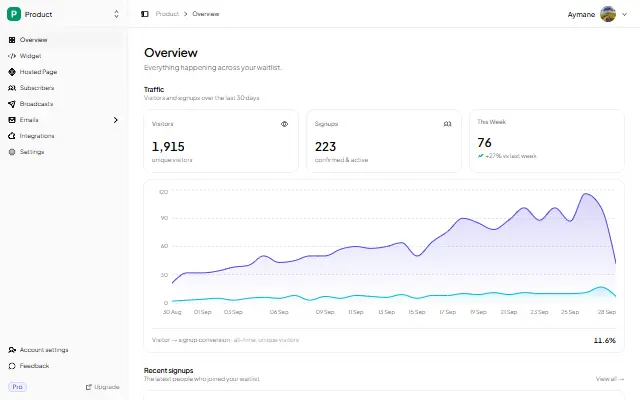
- Messaging testing — Your waitlist page conversion rate tells you if your message connects. Low signups? Change the headline. Repeat until it converts.
- Referral mechanism — A waitlist with referral links turns every subscriber into a promoter.
- Multi-channel destination — Every post, comment, and announcement points to one place. You build compound traffic instead of scattered attention.
If a waitlist is the right approach for your pre-launch, GetWaitly handles all four out of the box — an embeddable signup form, referral system, subscriber management, and broadcast emails. GetWaitly is the all-in-one waitlist for founders and makers. Free to start, no credit card required.
FAQ
How many waitlist signups should I have before launching?
For a B2B SaaS, 300-500 warm leads is a solid starting point — enough to create a meaningful launch day spike. For consumer products, aim higher. The number matters less than engagement: are your waitlist subscribers responding to emails? Sharing referral links? Those signals indicate real interest.
Is a soft launch better than a big launch?
For most solo founders, yes. A soft launch to your email list and close communities lets you iterate before the big push. Launch small, fix what breaks, then go broad.
Should I delay my launch until I have an audience?
If your product solves a painful problem right now, launch as soon as it works. But if the product can wait 30-90 days, investing that time in audience building will dramatically change your launch outcome.
What if my pre-launch campaign gets zero traction?
Zero traction is data, not failure. It means either the message doesn't connect, the audience doesn't exist yet, or the problem isn't painful enough. Before giving up, try changing your messaging and targeting a different community. If you still get zero after iterating, you've learned something valuable without investing months in building the wrong product.
What are the most common pre-launch mistakes?
Six, in rough order of how much they cost you: building in stealth, launching with no pre-built audience, depending on a single channel, failing to capture emails, never testing your messaging, and giving supporters no referral mechanism. The first three are strategic and take months to fix, so start early. The last three are tactical and can be fixed in an afternoon.
Why did my product launch get no signups?
Usually it's not the product — it's distribution. A launch is not the same as an audience. If nobody knew you existed before launch day, a launch email and a tweet reach almost no one. The fix is upstream: build a small audience or waitlist before launch, so launch day is a warm handoff to people who already opted in.
How do I know if my messaging is the problem?
Your conversion rate tells you. If people reach your waitlist page but don't sign up, the message isn't landing — the headline doesn't match what they expected, the value prop is unclear, or the CTA is buried. Test one variable at a time, starting with the headline. If traffic converts but nobody engages afterward, the problem is the offer or the audience instead.
Related guides
- Launch Day Playbook: How to Convert Your Waitlist into Paying Customers — executing a launch that avoids the conversion failures described in this guide
- How to Build a Referral Program That Grows Your Waitlist Before Launch — a complete guide to fixing the "no referral mechanism" failure mode
- How to Write a Waitlist Email Sequence That Converts — the email communication strategy that fixes the "no engagement" failure mode
- How to Build an Audience Before Your Product Is Ready — the full audience-building playbook for founders starting from zero
- The Solo Founder's Pre-Launch Playbook — a complete 30-day launch sequence with specific actions for each week
- How to Launch on Product Hunt — specific strategies for a strong Product Hunt launch that converts traffic into users
- How to Get Your First 100 Users — practical growth tactics once you have a live product
- Soft Launch: How to Run a Soft Launch Campaign (4 Approaches) — a controlled soft launch that de-risks the public launch

written by
Aymane E.
Founder of GetWaitly. I write about validating ideas, pre-launch, and growth from building a waitlist tool as a solo founder.
Follow on X