article
Email vs Waitlist vs Landing Page: Which Comes First? (In Order)
Landing page first, waitlist next, email last — how to sequence all three for a launch, with a comparison table and a week-by-week plan.

You want to validate your idea. Everyone tells you to set up a landing page. Or a waitlist. Or an email list — sometimes called an email waiting list. But which one comes first? And do you need all three?
The wrong order wastes time and effort. If you build a landing page when you should have started a waitlist, you get traffic you can't capture. If you build an email list when you should have tested messaging first, you collect subscribers who don't convert. Each channel has a specific job, and using them in sequence is more powerful than picking one.
Here's how to decide which comes first.
The short answer
Landing page first — to test your message. Waitlist next — to capture and measure demand. Email list last — to nurture and convert. They work as a funnel, not a menu. Pick the one that matches your current stage, then add the others as you progress.
The three channels compared
| Landing page | Waitlist | Email list | |
|---|---|---|---|
| Purpose | Test messaging and gauge interest | Capture demand and measure engagement | Nurture relationships and drive conversion |
| What you get | Page views, click-throughs, bounce rate | Email subscribers, referral shares | Open rates, replies, warm leads |
| Effort to set up | Low — one page, one headline | Low — one page + signup form | Medium — signup form + content to send |
| Time to first signal | Hours to days | Days to weeks | Weeks to months |
| Best stage | Pre-idea / early validation | Pre-product / audience building | Pre-launch / launch |
| Traffic needed | Yes — you need visitors | Yes — same traffic source, but better capture | Yes — needs more traffic or existing subscribers |
| Signal strength | Medium — views are noisy | High — email signup + referral = real interest | Medium — open rates and replies are softer signals |
Each channel has a place. The mistake founders make is picking one and stopping there, or trying to do all three at once without a clear sequence.
When to start with a landing page
A landing page is the fastest way to test whether your message connects. You write a headline, a subheading, and maybe a CTA button. You drive some traffic. You watch what happens.
This works when: You're early — pre-idea or pre-product. You don't know what message resonates or whether anyone cares about the problem you're solving. A landing page lets you iterate fast. Change the headline. Try a different angle. See what gets clicks.
Where it falls short: A landing page captures nothing. Visitors land, read, maybe click — and then they leave. Unless you have a signup form, every visitor is a lead you've lost forever. A landing page without a capture mechanism is a leaky bucket.
Best for: The first 1-2 weeks of validation, when the goal is messaging, not leads.
When to start with a waitlist
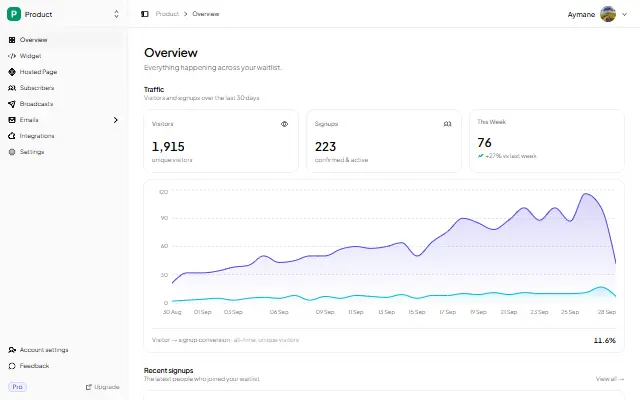
A waitlist page is a landing page with a signup form built in. Visitors see your message and can raise their hand with one email field. But a good waitlist does more than collect emails — it measures engagement. You can see how many people sign up, how many share their referral link, and how many respond to your updates.
This works when: You have a message that connects and you want to capture everyone who's interested. The waitlist becomes your central destination. Every post, comment, and announcement points to it. You build a list of warm leads who've opted in to hear from you.
Where it falls short: A waitlist needs traffic. If nobody visits your page, nobody signs up. And a waitlist on its own doesn't build relationships — you need emails and updates to keep subscribers engaged over time.
Best for: The audience-building phase, when you have a clear message and you want to capture demand while measuring who actually cares.
When to start with an email list
An email list is the most powerful channel for conversion. People on your email list have opted in, opened your messages, and decided they want to hear from you. When you launch, they're your most likely first customers.
For a pre-launch product, an email waiting list and a waitlist are the same thing in practice — a group of people who gave you their email address to hear about your launch. The label doesn't matter as much as how deliberately you nurture that list before launch day.
This works when: You have content to share and time to nurture. Email marketing takes consistent effort — writing updates, sharing insights, building trust. If you have a waitlist, you already have an email list — the difference is how you use it.
Where it falls short: An email list takes time to build. If you start from zero, you need weeks or months of consistent content before the list becomes a meaningful launch channel. And email converts best when combined with a destination — the waitlist or product page you're pointing people to.
Best for: The pre-launch phase, when you have subscribers and you need to warm them up before launch day.
The optimal sequence
Here's the sequence that works for most founders and makers.
Phase 1: Landing page (week 1-2)
Write one headline. One subheading. One CTA. Drive 100-200 visitors from a community or social post. See if anyone clicks. If not, change the message. Repeat until you see engagement.
The goal isn't signups yet. It's knowing whether your message makes sense to real people.
Phase 2: Waitlist (week 2+)
Once your message works, add a signup form. Make the landing page a waitlist page. Your first 10 signups tell you more than a hundred page views — they're people who actively opted in. Add referral links so early supporters can share.
Track signups and referral shares. If people are sharing, you have real demand. This is the moment to double down on audience building.
Phase 3: Email (week 4+)
Send a welcome email to new subscribers. Then a weekly or bi-weekly update on what you're building. Share lessons, not features. Build anticipation for the launch.
By the time you're ready to launch, your email list is warm. They know who you are, what you're building, and why it matters. Launch day isn't a cold introduction — it's an invitation.
How GetWaitly combines all three
Most founders end up juggling separate tools: landing page builder, waitlist service, email provider, referral tracking. That's three or four integrations to manage before you've validated anything.
GetWaitly is the simplest way to combine all three. You embed a signup form on the landing page you already have, referral links measure engagement, and broadcast emails nurture subscribers — without stitching together multiple tools. Free to start, no credit card required.
If a waitlist makes sense for your stage, it's worth trying before you build a complex stack of separate services.
FAQ
Can I skip the landing page?
If you're confident in your message — because you've talked to 20+ potential users directly — you can go straight to a waitlist. But most founders benefit from testing messaging with a simple landing page first. It's a cheap insurance policy against building the wrong thing.
Do I need both a waitlist and an email list?
A waitlist is the capture mechanism. An email list is what you do with those captured subscribers. They're the same thing used differently — a waitlist collects, email nurtures. You need both, but they can (and should) be the same tool.
What if I have no traffic?
None of these channels work without visitors. If you have no traffic, start with community engagement and building in public. Create content, answer questions, and participate in conversations where your target audience spends time. Drive people to your landing page or waitlist from there.
What is an email waiting list?
An email waiting list is a waitlist — a list of people who shared their email address to be notified about your launch. Most founders and tools use the two terms interchangeably. What matters isn't the label but the mechanics: capture the email, measure interest, send updates, and convert on launch day. A waitlist tool like GetWaitly handles the capture and the emailing in one place.
Should I use separate tools for each channel?
You can, but it adds complexity. A landing page builder, a waitlist service, an email provider, and a referral tracker means four logins, four integrations, and four learning curves. For early stage founders, fewer tools means more focus.
Should I start with a waitlist or a landing page?
Start with a landing page that contains a waitlist. The landing page sells the idea; the signup form captures everyone who says yes. They aren't either/or — the best first step is a single page with a waitlist form on it, which is exactly what GetWaitly gives you.
Related guides
- How to Write Waitlist Copy That Converts Visitors into Subscribers — writing the actual waitlist page once you've chosen it as your channel
- How to Know If Anyone Will Pay for Your Idea — testing willingness to pay before you build
- How to Validate a SaaS Idea Without Building Anything — five approaches to early validation
- How to Build an Audience Before Your Product Is Ready — audience-building strategies that feed into any channel
- Why Most Pre-Launch Campaigns Fail (And How to Fix Yours) — six failure modes that a sequenced approach prevents
- The Indie Hacker's Complete Pre-Launch Stack: 4 Tools You Actually Need (and 3 You Don't) — One tool replaces four. Here's the simple pre-launch stack for founders.
- Prefinery vs LaunchList vs GetWaitly — how the most established waitlist tool compares for founders.
- Carrd vs GetWaitly: Using Carrd as a Waitlist Form Builder — Carrd is great for landing pages but a pre-launch waitlist needs more. Here is when each tool fits.
- Product Hunt Launch Guide + Checklist (30-Day Timeline) — the launch channel that turns a traffic spike into users

written by
Aymane E.
Founder of GetWaitly. I write about validating ideas, pre-launch, and growth from building a waitlist tool as a solo founder.
Follow on X