article
The Indie Hacker Pre-Launch Stack (2026): 4 Tools, or Just One
Landing page, email, referrals, and analytics — most founders stitch together four tools before shipping anything. Here's the simple indie hacker pre-launch stack that replaces them with one, and costs nothing before you have revenue.

You need a landing page to capture signups. You need email to nurture subscribers. You need referral tracking to turn supporters into promoters. You need analytics to see what's working. That's four separate tools before you've shipped a single feature.
For indie hackers, the advantage is speed. You can validate, build, and launch faster than any team with meetings, budgets, and approval processes. But a complex indie hacker stack kills that advantage before you start. Stitching four indie hacker tools together takes days, costs more than it should, and adds mental overhead every time you need to check your numbers or send an update.
Here's the pre-launch stack for 2026 — the indie hacker tools that cover your bases with the fewest possible.
The best indie hacker pre-launch stack in 2026
The indie hacker pre-launch stack is one tool: a waitlist with an embeddable signup form, referral system, and email broadcasts. That's it. The best pre-launch stack for solo founders is one tool that replaces four. Add a custom domain and you're live. No integrations, no Zapier, no juggling logins.
Pre-launch tools: what your stack needs to do
Before you pick tools, know what you actually need. These are the four non-negotiable capabilities for any pre-launch stack.
Signup capture
Your signup form is your storefront. It's where traffic lands, where visitors decide whether your product is worth their email address, and where the first impression of your entire business happens.
What you need: A form that loads fast, works on mobile, and lets you customize the headline, description, CTA text, colors, and fonts. It should take minutes to set up, not hours.
What indie hackers overcomplicate: Building a custom signup system, wiring a form backend to a database, or spreading form, email, and tracking across separate services. That's three decisions and two integrations before you've written a single word of copy.
What actually works: A waitlist tool with an embeddable widget. You keep your existing landing page (Carrd, your own site, anything) and drop in a branded signup form — inline or popup — that matches your colors and fonts. The tool handles submission, confirmation, and referral tracking. The form is live the moment you hit save.
Email broadcasts
Your waitlist is useless without a way to communicate with it. Email is the channel that turns subscribers into launch day customers.
What you need: The ability to send broadcast emails to your subscribers, track who opens and clicks, and send follow-ups to specific segments. You don't need automation flows, drip campaigns, or templates yet.
What indie hackers overcomplicate: Signing up for Mailchimp, ConvertKit, or Resend, configuring DKIM and SPF records, building a separate subscriber list, and importing waitlist signups manually. This adds a full day of setup before you've sent a single email.
What actually works: A waitlist tool with broadcast email built in. Your subscribers are already in the system. You write an email, hit send, and see open and click rates in the same dashboard where your signups live.
Referral tracking
Referrals are the compounding growth engine for pre-launch. Every subscriber should have a unique link they can share.
What you need: Automatic referral link generation for every subscriber, tracking of how many people each person referred, and a mechanic that rewards sharing (moving up the waitlist, early access, or discounts).
What indie hackers overcomplicate: Building a custom referral system, using Viral Loops as a separate service, or tracking referrals in a spreadsheet. Custom builds take weeks. Separate services add another monthly subscription. Spreadsheets break the moment you have more than 50 subscribers.
What actually works: A waitlist tool with referrals built in. Every subscriber gets a unique link automatically. When someone joins through that link, the referrer moves up the list. No setup, no tracking, no extra cost.
Analytics
You need to know how many people signed up, where they came from, and whether your pre-launch efforts are working.
What you need: Signup count, conversion rate, referral source tracking, and a trend line that shows whether growth is accelerating or flatlining.
What indie hackers overcomplicate: Installing Google Analytics, setting up event tracking for signups, creating custom dashboards, and wiring referral data from a separate system. This is hours of setup for data you'll check for 30 seconds a day.
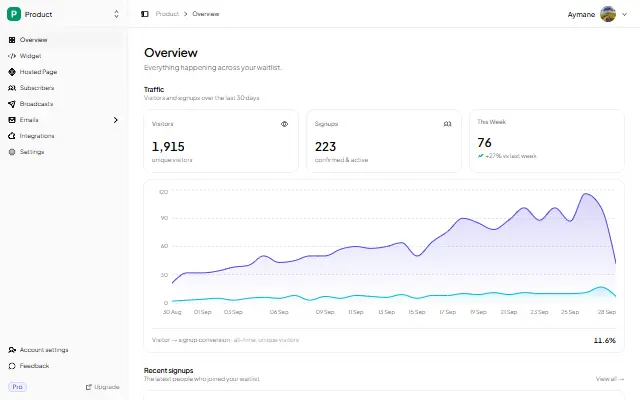
What actually works: A waitlist tool that shows your analytics in the same interface where you manage subscribers and send emails. Views, signups, conversion rate, and referral performance in one glance. No extra setup.
Tools indie hackers don't need before launch
Indie hackers overcomplicate their pre-launch stack more than any other group. Here are three things you genuinely don't need before launch.
A separate email platform
Mailchimp, ConvertKit, and Resend are powerful tools. You don't need them with fewer than 1,000 subscribers. A waitlist tool with built-in email handles everything: list management, broadcasts, open and click tracking. Add a dedicated email platform when you need automation, advanced segmentation, or team features — not before.
A CRM or spreadsheet
You don't need to manage subscribers in a separate system. Every signup should live in your waitlist tool. Exporting to CSV or syncing to a CRM before you have 100 subscribers is overhead that adds nothing. If you need to search, filter, or segment, your waitlist tool should handle that.
Zapier or integration chains
Connecting your landing page form to Google Sheets, which triggers an email in Mailchimp, which adds a row to your CRM, which sends a Slack notification — this is a common indie hacker setup. It's also four points of failure before you have a single customer. Every integration is something that can break, needs maintenance, and takes time to set up. One tool that does all four things removes every integration point.
Comparison table
| Need | Separate tools approach | Simple stack |
|---|---|---|
| Signup form | Form builder + backend + DB | Built into waitlist tool |
| Landing page | Carrd ($19/mo) or Webflow ($23/mo) | Keep your own site |
| Email broadcasts | Mailchimp ($13/mo) or Resend (pay per send) | Built in |
| Referral tracking | Viral Loops ($49/mo) or custom build (weeks) | Built in |
| Analytics | Google Analytics (free, complex setup) | Built in |
| Monthly cost | $30-100+ (3-4 tools) | Free – $5/mo |
| Setup time | 2-3 days integrating | 5 minutes |
| Logins to manage | 3-4 separate accounts | One |
The difference is not just cost. It's cognitive overhead. Every separate tool is a login to remember, a dashboard to check, a billing cycle to track, and an integration to maintain. For indie hackers working alone, that overhead matters. Your attention is your scarcest resource. Spend it on your product and your audience, not on tool management.
When to add more tools
The pre-launch stack described here is not your forever stack. It's what you need for validation, audience building, and launch. As you grow, you'll graduate to more specialized tools:
- 500+ engaged subscribers: Consider a dedicated email platform for advanced segmentation and automation.
- 5,000+ subscribers: Add a proper analytics platform (Plausible, PostHog) for deeper product analytics.
- 10,000+ subscribers: At this point you have revenue and a team. Your stack should grow with your needs.
Before those thresholds, every additional tool is premature optimization. The cost — in money, time, and attention — almost always outweighs the benefit.
GetWaitly is the simple pre-launch stack for indie hackers. It combines an embeddable signup form, referral system, broadcast emails, and analytics in one tool. Free to start, with paid plans from $5/mo — less than the cost of any single separate tool on the list. Start free in 5 minutes → No credit card required.
FAQ
What are the best indie hacker tools for pre-launch?
The best indie hacker pre-launch stack is a single waitlist tool that covers signup capture, email broadcasts, referral tracking, and analytics. For solo founders, minimizing tool count is a competitive advantage — every extra tool adds setup time, cost, and cognitive overhead. The comparison table in this guide shows the cost and time difference between the simple stack and the separate-tools approach.
When should I graduate to a bigger stack?
When you have 5,000+ engaged subscribers and need features your current tool doesn't offer — advanced automation, team collaboration, or deep integrations. Before that, consolidation is an indie hacker advantage. Every tool you don't add is time you keep for building.
Is one tool really enough for pre-launch?
Yes, if it covers the four essentials: signup capture, email, referrals, and analytics. These are not exotic needs. Every SaaS pre-launch requires them, and there's no benefit to spreading them across multiple services. The features matter more than the number of tools.
Does the landing page need a custom domain?
Not for validation, but yes for credibility. A custom domain ($10-15/year) makes your waitlist look professional. You can embed the form on your own site, or publish a GetWaitly hosted page on your own domain — either way the waitlist lives on a domain you control. The full pre-launch stack is: landing page + waitlist tool. No server to run, no CMS to manage.
What about social media and content marketing?
Those are channels, not tools. You don't need a separate tool to post on X or write a blog post. Social media and content are activities, not stack decisions. Your landing page is the destination. The channels bring people there.
What does this stack cost before I have any revenue?
Nothing. The free plan covers your first 100 subscribers, so your pre-launch stack costs $0 while you validate and gather your first indie hacker revenue. Paid plans start at $5/mo — less than any single separate tool on the list. You don't need revenue to launch a waitlist; you need a waitlist to find out if you'll earn any.
Related guides
- Email vs Waitlist vs Landing Page: Which Comes First? — choosing the right channel to build before you decide on your stack
- The Solo Founder's Pre-Launch Playbook — a 30-day plan that uses the simple stack to validate, grow, and launch
- Launch Day Playbook: How to Convert Your Waitlist into Paying Customers — what your pre-launch stack prepares you for
- How to Write Waitlist Copy That Converts Visitors into Subscribers — writing the landing page that your stack serves
- How to Build a Referral Program That Grows Your Waitlist Before Launch — referrals are part of your stack, here's how to design them
- Pricing Your First SaaS Product — pricing the product your simple stack helps you validate
- Prefinery vs LaunchList vs GetWaitly — how the most established waitlist tool compares for indie hackers.
- Carrd vs GetWaitly: Using Carrd as a Waitlist Form Builder — Carrd is great for landing pages but a pre-launch waitlist needs more. Here is when each tool fits.
- Best Waitlist Tools for Solo Founders in 2026: A No-Fluff Comparison — Six waitlist tools compared side by side. Which one should solo founders actually use?

written by
Aymane E.
Founder of GetWaitly. I write about validating ideas, pre-launch, and growth from building a waitlist tool as a solo founder.
Follow on X