article
Pre-Launch Referral Program Guide: 5 Mechanics That Work (2026)
How to launch a pre-launch referral program: five mechanics that grow a waitlist — position-based, milestone tiers, exclusive access, discounts, giveaways.

Your waitlist is growing. But it's growing one subscriber at a time. Every signup arrives through a single channel: a tweet, a forum post, a friend who happened to see your link. There's no compounding. No exponential curve. Just linear growth that flatlines the moment you stop promoting.
A referral program changes that. It turns every subscriber into a recruiter. Each person who joins has an incentive to bring the next person. Growth becomes self-sustaining, not because you bought ads or went viral, but because your existing supporters are doing the work for you.
If you're wondering how to start a referral program before your launch or how to launch a referral program for your startup, this guide covers exactly what you need: the mechanics that work, the setup steps, and how to turn early subscribers into your best growth channel.
A note on where this comes from: I built the referral system into GetWaitly and watched real waitlists use it. The biggest surprise wasn't which mechanic drove the most referrals — it was how many founders launched the program too late, after their most engaged subscribers had already gone quiet. Timing matters more than the reward.
The short answer
If you're wondering how to launch a referral program for your startup or how to launch a referral program for your waitlist, the process is simpler than you think: give each subscriber a unique link they can share. When someone joins through that link, the referrer gets a reward — moving up the waitlist, early access, or a discount. The mechanic is simple, but the effect is powerful: it turns your first 10 supporters into a distribution channel that grows with every new signup.
Five pre-launch referral program ideas that work
Not all referral programs are the same. The mechanic you choose shapes who shares and how often. Here are the five that work best for pre-launch.
1. Position-based (move up the list)
Every subscriber starts at the bottom. When someone joins through their referral link, they move up one position. The more people they refer, the higher they climb.
When it works: You have a clear waitlist that people care about being high on. Limited supply creates demand — if being first matters, this mechanic works.
Where it falls short: If your product is free or has no scarcity, position on a list means nothing. Referral activity drops when there's no perceived value in moving up.
Best for: Products launching with limited early access or tiered beta slots.
2. Tiered rewards — the milestone referral program
A milestone referral program rewards subscribers at set referral counts. Refer 3 friends → early access. Refer 10 → 50% off for life. Refer 25 → your name in the credits. Each milestone tier gives the subscriber a bigger incentive to keep sharing.
When it works: You have concrete rewards that are genuinely valuable. The tiers create a game-like progression that motivates continued sharing.
Where it falls short: Complexity kills participation. If subscribers need to track their own progress or the rewards feel out of reach, most people won't bother. Make the first tier easy to hit.
Best for: Products with clear pricing tiers and the ability to offer meaningful discounts or perks.
3. Exclusive access
Sharing unlocks something the subscriber wants — a private community, a beta invite, a live demo, or a one-on-one call with the founder.
When it works: The exclusive access is genuinely desirable. This works best for B2B products where networking or insider knowledge has real value.
Where it falls short: Soft rewards that feel like afterthoughts. "Exclusive access to our newsletter" is not a referral incentive — it's something they already have by being on the waitlist.
Best for: Founder-led products where personal access is a legitimate differentiator.
4. Lifetime discount
Refer a specific number of friends and receive a lifetime discount on the product. The classic "refer 3, get 50% off forever" model.
When it works: Your pricing is high enough that a lifetime discount feels significant. For a $15/mo product, 50% off saves $90/year — that's worth a few shares. For a free product, this mechanic doesn't apply.
Where it falls short: If your launch pricing is already discounted, a lifetime discount on top of that can feel confusing. Be clear about what the subscriber is getting.
Best for: Paid products with recurring billing where a lifetime discount has clear monetary value.
5. Giveaway entries
Every referral equals one entry into a prize draw. The prize could be a year of the product, a gift card, or something related to your niche.
When it works: The prize is compelling and the effort to enter is low. Giveaways work well in the earliest stages when you have very few subscribers and need a boost.
Where it falls short: Low-context prizes attract low-quality subscribers. People refer anyone for a chance to win, not because they believe in the product. Your list fills with people who don't care about your launch.
Best for: Initial burst of activity when you need momentum and have a compelling prize.
Comparison table
| Mechanic | Effort to set up | Virality risk | Quality of referrals | Best for stage |
|---|---|---|---|---|
| Position-based | Low | Low | High | Early → mid |
| Tiered rewards | Medium | Medium | High | Mid |
| Exclusive access | Low | Low | Very high | Early |
| Lifetime discount | Medium | Medium | Medium | Late pre-launch |
| Giveaway entries | Low | High | Low | Very early boost only |
How to launch a referral program: step-by-step setup guide
Step 1: Choose the right mechanic for your stage
If you have fewer than 100 subscribers, keep it simple. Position-based or exclusive access are the easiest to implement and won't dilute your list quality. As you grow toward 500+, introduce tiered rewards or a lifetime discount to maintain momentum.
The most effective pre-launch programs combine two mechanics: position-based as the default (every referral moves you up) with a tiered reward for top referrers (refer 10+ people and get something special). This gives everyone a reason to share while keeping your biggest supporters motivated.
Step 2: Make sharing frictionless
A referral link that requires digging through an email to find is a referral link that never gets shared. Put the link everywhere:
- The welcome email — first thing, above the fold
- Every broadcast email — include it naturally in the footer or as a P.S.
- The thank-you page after signup — this is when excitement is highest
- A dedicated "share your link" page accessible from the subscriber's profile
The easier you make it to share, the more shares you'll get. Every extra click between "I want to share" and "the link is copied" costs you referrals.
Step 3: Write compelling share copy
Default share text ("Join my waitlist!") is invisible. Give your subscribers words that work. Pre-write 2-3 options they can copy and paste:
- Short version for X/Twitter: "I just joined the waitlist for [product]. It's [value prop in 5 words]. Get your spot: [link]"
- Longer version for LinkedIn or email: "I've been following [product] and just joined their waitlist. They're solving [problem] in a way I haven't seen before. If that sounds useful, here's my referral link: [link]"
- Urgent version for DMs: "Hey, I know you're dealing with [problem]. I found something that might help — check it out: [link]"
Make it so easy to share that subscribers can do it in 10 seconds. The less effort required, the more shares you'll get.
Step 4: Track and optimize
Watch two numbers: referral share rate (what percentage of subscribers share their link) and referral conversion rate (what percentage of referred visitors sign up). These tell you if your incentive is working and if your messaging is effective.
If share rate is low, increase the incentive or make sharing easier. If conversion rate is low, improve the waitlist page that referred visitors land on — the problem might be your copy, not your referral program.
Step 5: Celebrate referrers publicly
When someone refers 5, 10, or 20 people, acknowledge them. A public shoutout on X or in your community makes them feel valued and shows others what's possible. "John just referred 15 people to the waitlist. He's getting early access and a lifetime discount. Who's next?"
Public recognition is a powerful motivator. It costs nothing and creates social proof that your referral program is worth participating in.
Referral program timing: when to launch a referral program (and when not to)
A referral program amplifies existing interest — it doesn't create it from nothing. If your product has no clear value proposition and nobody is signing up through organic channels, a referral program won't fix that. You need product-market fit before you need a referral mechanic.
Referral programs work when:
- Your waitlist is already growing, even slowly
- Early subscribers are actively engaged (opening emails, replying, asking questions)
- Your product solves a clear problem for a defined audience
They don't work when:
- You have zero subscribers and no distribution channel
- Your product is undefined or the value prop is unclear
- The incentive feels desperate or gimmicky
On referral program timing, the rule is simple: launch when you have your first 20-50 organic subscribers and they're showing signs of genuine interest. At that point, a referral system turns their enthusiasm into action. Turn the program on before launch day, not after — the weeks between signup and launch are when the compounding happens.
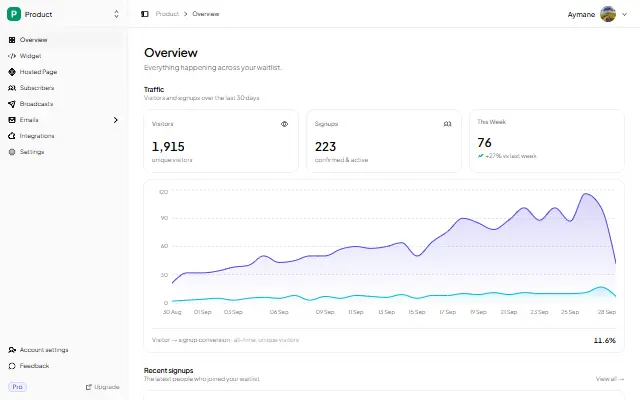
If you're using a waitlist tool that includes referral tracking, this step takes minutes instead of days. GetWaitly gives every subscriber a unique referral link automatically. When someone joins through that link, the referrer moves up the list — no manual tracking, no spreadsheets, no third-party tools. The same dashboard shows your signup and conversion data so you know what's working.
FAQ
How many subscribers do I need before launching a referral program?
20-50 engaged subscribers is the sweet spot. With fewer than 20, there aren't enough people to create momentum. With more than 50, you've already validated interest — a referral program at this stage accelerates growth rather than proving demand.
What's the best reward for a free product?
Exclusive access or position-based rewards work best. Since there's no pricing to discount, make sharing about status and early access. "Refer 5 people and get beta access 2 weeks early" is compelling even for a free product.
How do I prevent people from gaming the system?
Keep it simple. Don't offer rewards so valuable that people create fake accounts to claim them. If you're offering early access or a discount, the incentive to cheat is low because the reward is tied to genuine interest in your product. For position-based mechanics, the natural friction of creating fake signups usually outweighs the benefit.
What is a milestone referral program?
A milestone referral program rewards subscribers at set referral milestones. Hit 3 referrals → early access. Hit 10 → a lifetime discount. Hit 25 → a founder shoutout. Each milestone tier unlocks a bigger incentive, so participants keep sharing as they approach the next level. "Milestone referral program" and "tiered rewards" describe the same mechanic. Make the first milestone easy — 3 referrals, not 25 — so people feel progress immediately.
How to launch a referral program for my waitlist?
If you want to launch a referral program for your startup or pre-launch waitlist, start with the right mechanic for your stage. If you have fewer than 100 subscribers, use position-based rewards or exclusive access. Set up referral links so every subscriber gets one automatically. Put the link in your welcome email, broadcast emails, and thank-you page. Then track your share rate and conversion rate to see what's working. A pre-launch referral program doesn't need to be complex — the key is making sharing frictionless and rewarding the right behaviour. The full step-by-step is in the setup section above.
Should I tell subscribers about the referral program on the signup page?
Yes. Mentioning the referral incentive on your waitlist page increases signup conversion. "Every subscriber gets a unique referral link — share it to move up the list" is a feature description and a reason to join. Place it below the email field or beside the CTA button.
Related guides
- Launch Day Playbook: How to Convert Your Waitlist into Paying Customers — converting the engaged subscribers your referral program creates on launch day
- How to Build an Audience Before Your Product Is Ready — referrals as one of several zero-cost growth strategies for solo founders
- Why Most Pre-Launch Campaigns Fail (And How to Fix Yours) — how a missing referral mechanism is one of the six predictable failure modes
- How to Get Your First 100 Users as a Solo Founder — activating referrals is step five in the first-100-users playbook
- How to Write Waitlist Copy That Converts Visitors into Subscribers — writing the signup page that captures the subscribers your referral program will turn into promoters
- How Robinhood Grew to 1M Users with a Waitlist (Case Study) — the referral waitlist this guide is modeled on
- How to Write a Waitlist Email Sequence That Converts — where to place the referral link in each email of your pre-launch sequence
- Waitlist with Referral Tracking — the tracking feature behind this program
- The Indie Hacker's Complete Pre-Launch Stack: 4 Tools You Actually Need (and 3 You Don't) — One tool replaces four. Here's the simple pre-launch stack for founders.
- Prefinery vs LaunchList vs GetWaitly — how the most established waitlist tool compares for founders.
- Carrd vs GetWaitly: Using Carrd as a Waitlist Form Builder — Carrd is great for landing pages but a pre-launch waitlist needs more. Here is when each tool fits.
- Best Waitlist Tools for Solo Founders in 2026: A No-Fluff Comparison — Six waitlist tools compared side by side. Which one should solo founders actually use?
- Soft Launch: How to Run a Soft Launch Campaign (4 Approaches) — pairing referrals with a controlled soft launch
- Waitlist Benchmarks: Conversion, Referral & Email Rates — the referral and conversion numbers to aim for
- Waitlist Glossary: 16 Terms Every Founder Should Know — plain-English definitions for referral and waitlist terms
Ready to turn your waitlist into a growth engine? Start a free waitlist with referrals in 5 minutes. No credit card required.

written by
Aymane E.
Founder of GetWaitly. I write about validating ideas, pre-launch, and growth from building a waitlist tool as a solo founder.
Follow on X