article
Launch Day Playbook: How to Convert Your Waitlist into Paying Customers
A complete launch day playbook and launch day checklist for solo founders. The 24-hour timeline, email strategy for hot/warm/cold segments, conversion benchmarks, and a two-week post-launch plan to turn subscribers into paying customers — including what to do if you're launching tomorrow.

Your waitlist has 1,000 subscribers. Emails are pre-written. The product is ready. Launch day arrives. You hit send and wait. What happens in the next 24 hours determines whether those 1,000 subscribers become your first customers or a list of people who never hear from you again.
The gap between "someone joined your waitlist" and "someone buys your product" is not automatic. You can build the best product in your space, but if launch day execution is sloppy, most of those subscribers will never convert. The difference between a successful launch and a disappointing one is not your product. It's the playbook you follow on the day that matters most.
This launch day playbook and launch day checklist covers every step — from the prep work two weeks before to the emails, timing, and conversion tactics that turn waitlist subscribers into paying customers.
This is written from having done it: I launched GetWaitly, watched launch-day attention fade, and only got my first paying customer two months later — after a single user found the product and stuck around while I fixed it. The launch email gets attention. The follow-up is what converts it.
Launch day cheat sheet
A successful launch day typically converts 5-15% of your waitlist into paying customers. That range is a commonly reported benchmark rather than a guarantee — it varies by niche, price, and how warm your list is. Hitting it requires three things: segmenting your list by engagement before launch, sending the right emails at the right times on launch day, and following up strategically in the two weeks after. Without a plan for each of these, you leave most of your subscribers on the table.
Launch day checklist: the pre-launch setup
The work that determines launch day success happens in the two weeks before, not on the day itself.
Segment your list
Not all waitlist subscribers are equal. Someone who joined six months ago and never opened an email is not the same as someone who replied to every update and shared their referral link with ten friends. Send the same email to both and you're wasting the opportunity.
Divide your list into three segments:
Hot: Opened the last 2+ emails, clicked a link, or shared their referral link. These people are excited. They need a clear path to buy and a reason to act now.
Warm: Joined recently or opened the last email but didn't click. They're interested but not committed. They need more convincing and social proof.
Cold: Joined months ago or hasn't opened the last 3+ emails. They forgot about you. They need a re-engagement attempt with a different angle.
Pre-write every email
Launch day is chaotic. You don't want to write emails while managing support requests, fixing last-minute bugs, and responding to social media. Write everything at least a week in advance:
- The "we launch tomorrow" email
- The launch email (two versions: one for hot/warm, one for cold)
- The day 2 follow-up for non-openers
- The day 3 re-engagement email
- The day 7 social proof email
- The day 14 last chance email
Test your payment flow
This sounds obvious, but it's the most common launch day failure. Go through the entire purchase flow yourself. Then have two friends do it. Test on mobile and desktop. Test with a card that declines. Test with a card that succeeds. Every error message you discover before launch is a customer you won't lose on launch day.
If you're using a payment provider like Lemon Squeezy, confirm that your checkout links work, your webhooks are configured, and your subscription management flow handles upgrades, cancellations, and failures correctly.
Prepare your analytics
Before you launch, know exactly what you'll track. At minimum:
- How many people opened each email
- How many clicked through to your pricing or checkout page
- How many completed a purchase
- Which segment each buyer came from
- Which referral sources drove the most conversions
These numbers tell you what worked and what to fix. Without them, you're guessing.
Launch day timeline and checklist
T-24 hours: The "launching tomorrow" email
Send this to every segment. The goal is anticipation, not conversion. Keep it short:
"We launch tomorrow at 9 AM ET. Here's what you need to know: [price, what's included, launch discount if any]. Your referral link still works if you want to share with friends before the launch."
This email does two things. It makes sure your launch doesn't feel sudden, and it gives subscribers one more chance to refer people before the launch goes live.
T-0 hours: Launch email to hot and warm segments
This is the email you've been building toward. Send it to hot and warm segments first. Keep cold for later with a different approach.
What it needs:
- A clear statement that the product is live
- What the subscriber gets by acting now (launch discount, early adopter status, bonus)
- One primary call to action (buy now, start trial, book a demo)
- Social proof if you have it (early users, testimonials, press coverage)
- Their referral link one more time
The subject line should be direct and specific. "We're live" is too vague. "[Product] is live and here's your launch discount" is better. "You now have early access to [product], plus 30% off until Friday" is specific enough to earn an open.
T+3 hours: Social media and community posts
Your email subscribers are your primary channel, but social media amplifies them. Post on X, LinkedIn, and any communities where you're active. Include a link to your product page, not your waitlist page. The waitlist phase is over.
If you have referral power users (people who referred 5+ subscribers), DM them personally. Thank them, remind them their referral link still works, and offer an extra perk if they help spread the word on launch day.
T+6 hours: Cold segment email
By now, your hot and warm segments have had time to open and act. Send a different email to the cold segment. Change the subject line and the opening. These people didn't engage with your previous emails, so the approach that worked for warm subscribers won't work for them.
Try a curiosity-driven subject line: "We launched and here's what happened." Or a benefit-focused one: "Still dealing with [problem]? We built something for you."
The body should re-introduce your product as if they're hearing about it for the first time. Assume they forgot everything. Keep it shorter than the main launch email.
T+12 hours: Personal engagement
By now, replies are coming in. Some people have questions before buying. Some need reassurance. Some are having technical issues. Respond to every reply within a few hours on launch day. Quick, helpful answers can turn a hesitant subscriber into a customer.
Also reach out to your top referrers and most engaged subscribers. A personal message from the founder goes a long way. "Hey, you've been one of our biggest supporters. I wanted to make sure you got your launch discount link."
T+24 hours: Day 2 follow-up (non-openers only)
Send a second email to everyone who didn't open the launch email (from either the hot/warm or cold send). Change the subject line completely. A common tactic is to use a testimonial or social proof angle: "500 people joined in the first 24 hours. Here's what they're saying."
The body can be shorter. The goal is to reach people who missed the first email, not to re-sell the entire product. Include the same CTA and discount if applicable.
Launch day conversion funnel
The ranges below are rough benchmarks reported across launches — use them as directional targets, not guarantees.
| Stage | Target rate | What it means |
|---|---|---|
| Waitlist → email open | 50-60% | Subject line quality is good |
| Email open → landing page click | 10-15% | CTA and offer are compelling |
| Landing page → checkout start | 30-50% | Pricing page answers objections |
| Checkout start → paid signup | 60-80% | Payment flow is frictionless |
| Overall waitlist → paid | 5-15% | Everything is working together |
If your numbers fall below these ranges, here's where to look:
Low open rate: Your subject line doesn't stand out. Make it more specific, add urgency, or include a number. "We launched" becomes "We launched: 30% off for the first 50 customers."
Low click rate: Your email content doesn't drive action. The CTA might be buried, the offer might not be compelling enough, or the email might be too long. Shorten it and make the CTA the most prominent element.
Low checkout start rate: Your pricing or landing page isn't convincing visitors. The value prop might be unclear, the price might feel too high, or there might be hidden friction (account creation required, unclear what happens after purchase).
Low checkout completion: Your payment flow has issues. Test it yourself. Common problems: declined cards without clear error messages, confusing subscription selection, or missing payment methods.
Post-launch week
Day 3: Re-engagement for non-buyers
Send an email to everyone who opened but didn't buy. Don't push harder. Instead, address the objections they probably have:
- "Still not sure? Here are the three questions I get most often."
- Offer a live demo or a one-on-one call.
- Share a case study or early user story.
The tone should be helpful, not desperate. Some people need more time. That's normal.
Day 7: Social proof email
Send to everyone who hasn't bought yet. Share what's happened in the first week: how many people joined, what they're saying, any press or mentions. Social proof is one of the strongest conversion drivers for hesitant buyers.
"We launched 7 days ago and 300 people have signed up. Here's what a few of them said about [product]."
Include 2-3 short testimonials. Keep the CTA the same.
Day 14: Last chance (if you had a launch discount)
If you offered a limited-time launch discount, day 14 is the right time to expire it. Send a "last chance" email to everyone who hasn't bought:
"Our launch discount ends in 48 hours. After that, the price goes to [regular price]. Here's your link to claim it."
If you didn't offer a discount, skip this email and send a regular update instead. Share product improvements or new features that launched post-launch.
What to do if conversion is lower than expected
Not every launch hits the 5-15% range. If you're below it, don't panic. Diagnose first.
Check your pricing. If your product is priced high relative to the value, even interested subscribers will hesitate. Compare your pricing to alternatives. Consider a lower launch price or a free trial.
Survey non-buyers. Reply to a handful of people who opened but didn't buy. Ask them directly: "What stopped you from signing up?" You'll get honest answers that tell you exactly what to fix.
Extend the discount. If the discount deadline passed and conversion was low, extending it one more week won't hurt. "We decided to keep the launch discount open until [date] since so many of you asked for more time."
Lower your target. A 3% conversion from a 500-person list is 15 customers. That's a real start. Focus on making those 15 customers successful, gather testimonials, and iterate. The next cohort will convert better.
Why some waitlists convert better than others
The conversion rate of your waitlist is determined before launch day. The subscribers who joined through a referral link are more likely to buy than those who found you through a random Google search. The subscribers who opened every email are more likely to buy than those who never clicked a single link.
A well-built waitlist with engaged subscribers and a referral program will consistently outperform a larger list of cold, unengaged signups. This is why the work you do before launch matters as much as launch day itself. If you nurture your list well, launch day becomes a formality.
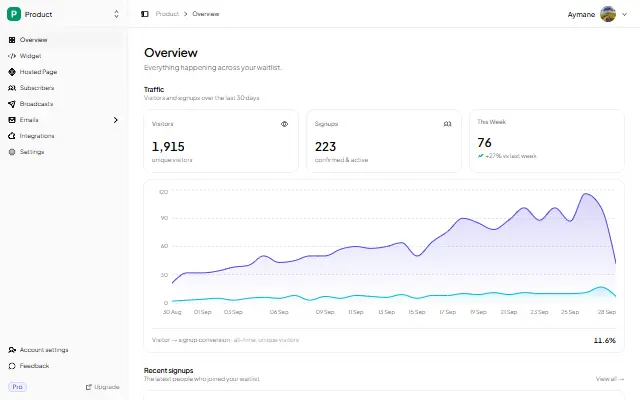
If you're using a waitlist tool with analytics, you can track engagement signals from day one. GetWaitly's dashboard shows you who's opening emails, who's clicking links, and who's sharing their referral link. When launch day comes, you already know which segments are hot and which need more work. The broadcast system tracks open and click rates per email, so you can optimize your launch sequence based on real data instead of guessing.
FAQ
What should I do if I'm launching tomorrow?
Run this emergency checklist in the next 24 hours: send the "we launch tomorrow" email to your whole list, test your payment flow end to end (yourself plus two friends, on mobile and desktop), pre-write the launch emails for your hot/warm and cold segments, confirm your analytics track opens, clicks, and checkouts, and schedule your social posts for T+3 hours. You can still segment by engagement in a single evening if your waitlist tool tracks opens and clicks. If it does not, send the launch email to everyone and follow up with non-openers on day 2.
What is a launch day playbook and why do I need one?
A launch day playbook is a step-by-step plan for the 24 hours around your product launch. It covers segmenting your waitlist, writing and timing your emails, engaging with subscribers, and troubleshooting issues in real time. You need one because launch day is chaotic — without a plan, you waste the audience you spent months building. This launch day checklist gives you every step in order.
What conversion rate should I expect from my waitlist?
5-15% is a commonly cited healthy range for a well-nurtured waitlist. Below 5% means something is off with pricing, positioning, or engagement. Above 15% is exceptional and usually indicates strong product-market fit or a highly compelling launch offer.
How long should my launch discount last?
7-14 days is standard. Long enough that people don't feel rushed into a bad decision, but short enough to create genuine urgency. If your product has a higher price point ($50+/mo), lean toward 14 days. For lower price points, 7 days is enough.
Should I launch to everyone at once or in waves?
Start with your hot segment first, then warm, then cold. Sending to everyone simultaneously can overwhelm your support capacity and make it harder to diagnose issues. A staggered launch over 6-12 hours gives you time to fix problems before they affect your entire list.
What if my payment provider fails on launch day?
Have a backup plan. If your primary payment provider goes down, you should have a way to capture purchases manually or redirect to an alternative checkout. At minimum, have a status page ready to communicate with subscribers if things break. Radio silence during a payment outage kills trust faster than the outage itself.
When should I stop optimizing for launch day and start focusing on growth?
The first week after launch is still launch day optimization. After day 14, switch to growth mode. Post-launch growth is a different playbook: content marketing, paid acquisition, partnerships, and product-led growth. The subscribers who didn't convert in the first two weeks are unlikely to convert later without a significant change in your product or messaging.
Related guides
- Waitlist Benchmarks: Conversion, Referral & Email Rates — the formulas and ranges behind your launch conversion rate
- Waitlist Glossary: 16 Terms Every Founder Should Know — conversion rate, k-factor, and the rest, in plain English
- What My First Paying Customer Taught Me About Launching — what happens after launch day, and how the first customer actually arrives
- How to Write a Waitlist Email Sequence That Converts — the 5-email sequence that leads subscribers to launch day ready to buy
- Pricing Your First SaaS Product — pricing decisions that directly affect your launch day conversion rate
- How to Build a Referral Program That Grows Your Waitlist Before Launch — referrals that drive engaged subscribers who convert at higher rates
- How to Get Your First 100 Users as a Solo Founder — converting your launch day customers into your first 100 active users
- The Art of the Soft Launch — when to launch quietly to a smaller audience before the main event
- Why Most Pre-Launch Campaigns Fail (And How to Fix Yours) — the failure modes that kill launch day conversion before it starts
- Product Hunt Launch Guide + Checklist (30-Day Timeline) — running a Product Hunt launch alongside your own launch day
- How to Build an Audience Before Your Product Is Ready — creating the demand that makes launch day successful
- The Indie Hacker Pre-Launch Stack (2026): 4 Tools, or Just One — one tool replaces four. Here's the simple pre-launch stack for founders.
- Prefinery vs LaunchList vs GetWaitly — how the most established waitlist tool compares for founders.
Your launch day is the culmination of every email you wrote, every subscriber you nurtured, and every referral link you sent. GetWaitly is the affordable waitlist for founders and makers. Start free in 5 minutes → No credit card required.

written by
Aymane E.
Founder of GetWaitly. I write about validating ideas, pre-launch, and growth from building a waitlist tool as a solo founder.
Follow on X